


In the matrix
Chromium supports the self-repairing passive oxide film and also increases hardenability. Molybdenum can improve resistance in some chloride-bearing environments and participates in the heat-treatment response.

Find your knife
From compact everyday carry to full-size field tools, start with the way you plan to use your knife.
Start here
Built for the job
See how steels, handle materials, sheath systems and controlled processes become a complete Kizlyar Supreme knife.
Explore the essentials
 The complete guideOpen Materials & Technologies
  Explore the hub sectionBlade steels
  Explore the hub sectionTechnologies & finishes
 Evidence before adjectives
Explore how steel choice, heat treatment, geometry and finishing shape performance in the real world.
Featured expert guides
Made in Dagestan
Meet the people, production experience and ideas behind Kizlyar Supreme knives.
Company essentials
Here when you need us
Find warranty information, authorised dealers and direct help from Kizlyar Supreme.
Support essentials
Carbon for hardness, chromium for stainless performance, vanadium for lasting wear: discover how alloy design and Kizlyar Supreme know-how turn the recipe into a rewarding knife
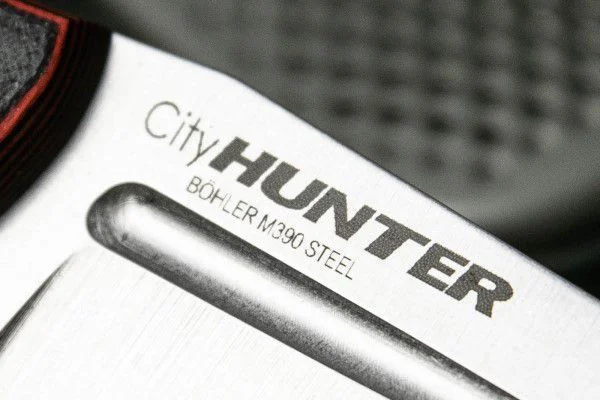
A chemical analysis states how much of each element entered the melt. It does not state where those atoms are after hardening, how large the carbides are, how clean the steel is, how much austenite remains or how the edge was ground. Those details decide whether the composition becomes a good knife.
A percentage table describes the melt. Knife performance appears only after the alloy has solidified, been worked, heat treated, ground and matched to a real edge geometry.
The order below is a practical way to understand knife alloys: first the iron–carbon hardening foundation, then corrosion, then hard-particle architecture, then transformation and manufacturing tools. In a marine knife, chromium and nitrogen may dominate the brief; in an abrasive cutter, vanadium carbides may matter far more.
Iron (Fe) is the base of steel and supplies the crystal structures in which alloy design operates. During hardening, the matrix changes to austenite and then, with sufficiently rapid cooling, to martensite.
Carbon (C) is the central hardness driver in most knife steels. Carbon dissolved in the matrix strengthens martensite; carbon combined with chromium, vanadium, molybdenum, tungsten or niobium forms carbides. More carbon is not free performance: excess can raise carbide volume, increase retained-austenite burden, consume chromium and reduce toughness or fine-edge stability.[1]
The heat-treatment target is therefore not “dissolve everything.” It is to dissolve the right fraction, leave the intended carbide population and build a matrix that can support the designed edge.
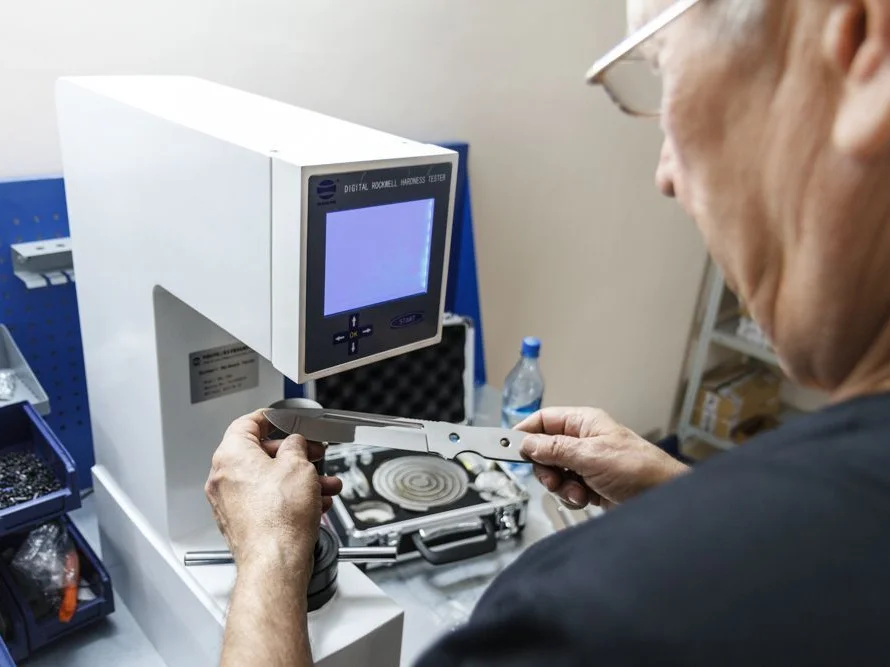
Chromium (Cr) is the principal corrosion-resistance element in conventional stainless knife steels, but nominal percentage is an incomplete metric. Chromium dissolved in the matrix supports passivity; chromium bound into carbides contributes to hard particles instead.[1]
Chromium supports the self-repairing passive oxide film and also increases hardenability. Molybdenum can improve resistance in some chloride-bearing environments and participates in the heat-treatment response.
Chromium carbides are hard and can add wear resistance, but large primary chromium carbides can impair toughness and sharpening and leave less chromium available in the matrix.
Austenitizing controls carbide dissolution. Too little or too much changes hardness, retained austenite, carbide population and corrosion behaviour. The proper window is grade-specific.
Hard carbides and nitrides can protect the softer matrix from abrasive wear. Their value depends on type, size, volume, distribution and how firmly the matrix supports them.
A strong carbide former. Vanadium carbides are extremely hard and stable, supporting abrasive wear resistance and, in suitable amounts, grain control. High or coarse carbide populations can make a fine edge less damage-tolerant.
Think: durable hard particles, not automatic overall superiorityPromotes hardenability, carbide formation and resistance to softening during tempering. In martensitic stainless grades it can also assist corrosion performance. Its exact role changes with carbon and the other carbide formers.
Think: heat-treatment response plus carbide and corrosion supportForms hard, abrasion-resistant carbides and helps steels retain hardness at elevated temperature. Hot hardness is vital in high-speed cutting tools and less directly valuable in a hand knife, but tungsten still changes carbide and tempering behaviour.
Think: wear and temper resistance with a processing and cost burdenForms very stable, hard carbides. Purpose-designed additions can create a fine wear-resistant particle population and limit grain growth, but niobium must be balanced with carbon and the production route.
Think: specialised carbide control, not a bonus point on a labelCan strengthen the matrix and form hard nitrides while imposing less of carbon’s chromium-carbide penalty. Significant nitrogen levels require specialised steelmaking; Uddeholm Vanax shows how a nitrogen-rich PM design can combine corrosion and wear goals.[4]
Think: a different route to hardness and hard particlesBelongs in both chapters: it is a corrosion element and a carbide former. This double duty is why carbon–chromium balance and heat treatment are central to martensitic stainless knife design.
Think: allocation between passivity and carbide structureSome elements work mainly through the matrix, phase stability or steelmaking process. Their effect cannot be inferred from presence alone.
| Element | Typical metallurgical role | Why more is not automatically better |
|---|---|---|
| Co — Cobalt | Strengthens the matrix and can support secondary hardening or resistance to temper softening in certain alloys; it is not a conventional carbide former.[3] | Hot-hardness benefits developed for high-speed tools may not translate directly to a room-temperature knife. It also changes heat-treatment requirements and cost. |
| Ni — Nickel | Can improve toughness and corrosion behaviour and stabilises austenite. It is widely used where ductility or low-temperature toughness is important. | Excess austenite stability can complicate full martensitic transformation in a hard knife blade. Nickel is not a primary wear-carbide solution. |
| Mn — Manganese | Supports deoxidation and hardenability and helps control sulfur during steelmaking. | Its optimum depends on the system; excessive levels can increase retained-austenite or segregation concerns. Some precision knife grades deliberately keep it low. |
| Si — Silicon | Commonly acts as a deoxidiser and can strengthen the matrix and influence tempering. | High levels can impair processing or toughness in some designs. A residual amount is not evidence of cutting performance by itself. |
| S / P — Sulfur and phosphorus | Usually controlled residuals. Sulfur may be raised in free-machining steels because sulfide inclusions ease cutting during manufacture. | Sulfides can initiate pitting and reduce toughness; phosphorus can embrittle boundaries. A clean knife steel normally controls both closely.[1] |
The same element can help one phase and deprive another. Alloy designers therefore tune interactions, not isolated percentages.
Moderate carbon and sufficient chromium can prioritise corrosion resistance, toughness, manufacturability and easy maintenance over maximum carbide wear resistance.
More carbon plus strong carbide formers can create long abrasive wear life, while PM or remelting may be needed to control segregation, carbide size and toughness.
Replacing part of the carbon with nitrogen can leave more chromium in the matrix while forming hard nitrides, but demands specialised melting and consolidation.
Böhler N690 averages 1.08% carbon, 17.30% chromium, 1.10% molybdenum, 1.50% cobalt and 0.10% vanadium.[5] Those numbers describe the alloy design; they do not specify the final blade hardness, carbide condition, retained austenite, edge geometry or quality of processing.

This 2019 Kizlyar Supreme interview with a Böhler representative discusses N690, Sleipner, K340, M390/M398 and powder metallurgy. It is valuable historical context; availability and catalogue statements in the film are not treated as current product data.
Advanced metallurgy improves combinations; it does not turn alloying into a free buffet.
Carbon and chromium cannot simultaneously occupy every desired carbide and matrix position. More of one phase means less chemistry available elsewhere.
High alloy totals can segregate during conventional solidification and form large primary carbides. PM reduces those problems but does not make carbide volume irrelevant.
More hardness and hard particles can increase wear resistance while narrowing toughness, sharpening or edge-stability margins.
Alloy availability, mill form, forging window, hardening temperature, retained austenite, grinding abrasives, distortion and cost determine whether a design can be produced consistently.
A steel must support the chosen edge angle and blade section. The alloy that excels in a controlled slicer may not tolerate the geometry and impacts of a large field knife.
Salt exposure, care habits, field sharpening and budget are engineering inputs. A theoretically higher property that the user cannot exploit may have no practical value.
There is no universal ranking. Iron is the base and carbon is the primary hardness driver in most knife steels; chromium becomes central when corrosion resistance is required. The task then determines the value of carbide formers, nitrogen and supporting elements.
No. Carbon can increase martensitic hardness and carbide volume, but excess can increase retained austenite, brittleness and primary carbides and can tie up chromium needed for corrosion resistance.
Not by itself. Corrosion resistance depends strongly on chromium dissolved in the matrix after heat treatment, as well as other elements, surface condition and environment. Chromium tied up in carbides serves a different role.
They form very hard, stable carbides that can improve abrasive wear resistance and influence grain control. Their usefulness depends on particle size, volume, distribution, matrix support and production route.
In suitable alloy designs, nitrogen can strengthen the matrix and form hard nitrides with less of carbon’s tendency to consume chromium in carbides. Achieving high nitrogen content requires specialised steelmaking.
No. You also need steel cleanliness and microstructure, heat treatment, hardness, retained austenite, blade and edge geometry, finish, quality control and intended use.
Discover the know-how behind our blades and find a Kizlyar Supreme knife that fits the way you work.
Explore our blade steels—from practical easy-care options to premium wear-resistant grades—and discover the Kizlyar Supreme knife that fits your priorities.