Kizlyar Supreme metallurgy guide

Thermocycling steel

What repeated, controlled heating and cooling can change—and why a promising metallurgical method still has to earn its place in a knife-production route

Evidence reviewed 10 September 2026 · Sources and limits stated below
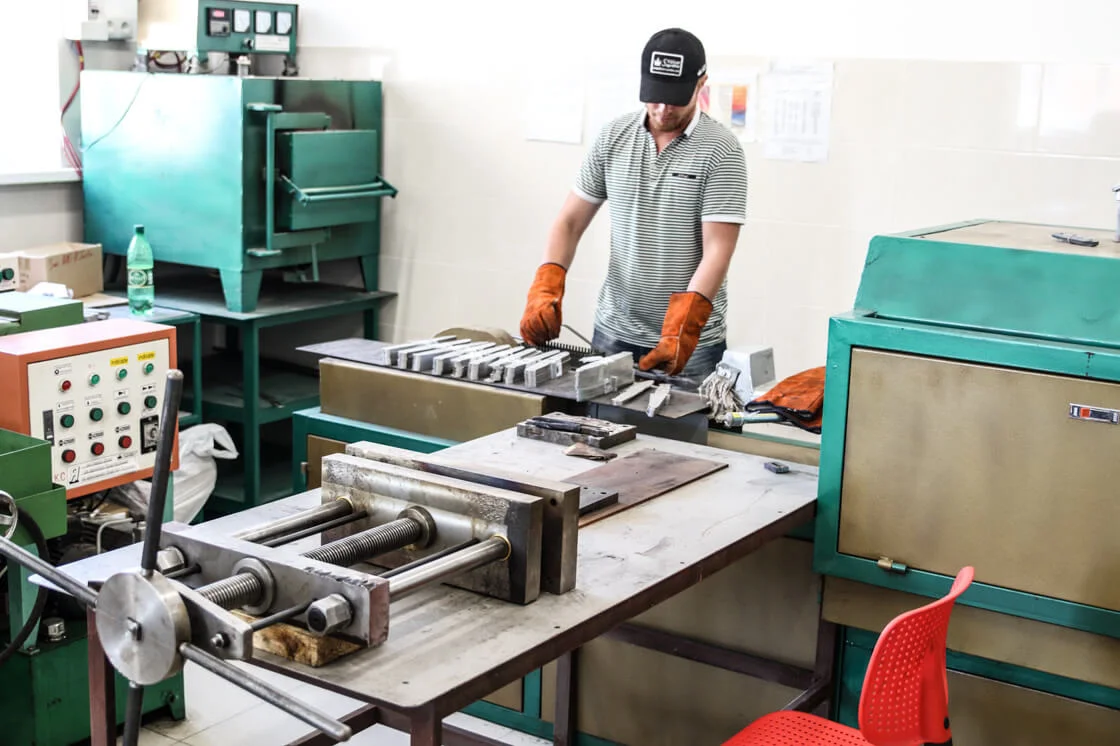
Controlled heat-treatment equipment inside the Kizlyar Supreme knife factory
The precise definition

One name, several different processes

Thermocycling is a family of treatments in which steel passes through repeated, deliberately controlled heating and cooling stages. The cycles may cross transformation temperatures, remain below them, use rapid heating or long holds, and target different structures. A result from one route cannot be transferred to another merely because both are called “thermocycling.”

RepeatedMore than one defined heating-and-cooling cycle
Transformation-awareThe phase ranges crossed determine what can change
Steel-specificChemistry and starting structure govern the response
Experiment-ledA conventional control is essential before claiming a benefit
One cycle, visually

Heat, transform, cool, measure—and only then repeat

The number of cycles is not the science. Peak temperature, heating and cooling rate, time above transformation ranges, starting structure and the measured result define the treatment.

Controlled heatingCross only the intended transformation range and limit unwanted grain growth.
Nucleate and transformNew phases form at available sites; the balance between nucleation and growth matters.
Defined coolingThe path determines which transformations occur before the next controlled reheating.
Measure before claimingCompare matched controls for structure, hardness, toughness, corrosion and knife behaviour.
KS
R&D
Research discipline is part of manufacturing authorityKizlyar Supreme presents thermocycling as an evidence-led development subject—not a marketing checkbox. A model-level claim should follow documented, repeatable steel-specific validation.

Not ordinary multiple tempering

A steel may receive several tempers after hardening without undergoing the grain-refining cyclic re-austenitization discussed in early Western research. Likewise, a Soviet high-temperature strengthening route is not automatically equivalent to rapid cyclic heating. The exact temperature path—not the label—defines the treatment.

Development history

From rapid heating experiments to tool-steel programmes

The history is not a straight line toward a single universal cycle. Researchers in different countries developed related approaches for different steels and production problems.

1960s–1971

Rapid cyclic austenitization

R. A. Grange investigated very rapid heating through the critical range and repeated cycles as a route to ultrafine austenite grains. His paper and reissued patent describe progressive refinement until grain growth and nucleation reach a practical limit.[1][3]

1973

Measured grain refinement

Mahajan, Pande and Imam reported an ultimate grain size of about 4 μm after four rapid cycles in the commercial medium-carbon steel they studied, together with higher yield stress and improved ductile-fracture behaviour.[2]

Soviet research

Strengthening cycles

V. K. Fedyukin and other researchers developed a broader school of thermocyclic treatments for steels and cast irons. These included high-temperature routes designed for particular alloys and engineering components.[7]

Later applied work

R18 and Х12МФ

Published studies examined optimized cycles for R18 high-speed steel and Х12МФ die steel. They are useful evidence that cycling can alter tool steels—but not permission to copy their schedules or performance figures to knife blades.[4][6]

Possible mechanisms

Why cycling can change microstructure

Repeated nucleation can refine prior-austenite grain. On reheating through the transformation range, new austenite forms at favourable sites. If heating and holding are controlled so that nucleation outruns grain growth, another cycle can begin from a finer structure.[1][2]

Carbides may dissolve and re-form differently. In alloy tool steels, cycling can redistribute some carbon and alloying elements and alter the size, shape or distribution of portions of the carbide population. What changes depends strongly on carbide stability, peak temperature, hold time and cooling path.

Transformation defects and retained phases may change. Repeated martensitic or diffusional transformations can alter defect density, stresses and retained austenite. These mechanisms are alloy- and route-dependent; they should be demonstrated by microscopy or phase measurement rather than inferred from hardness alone.

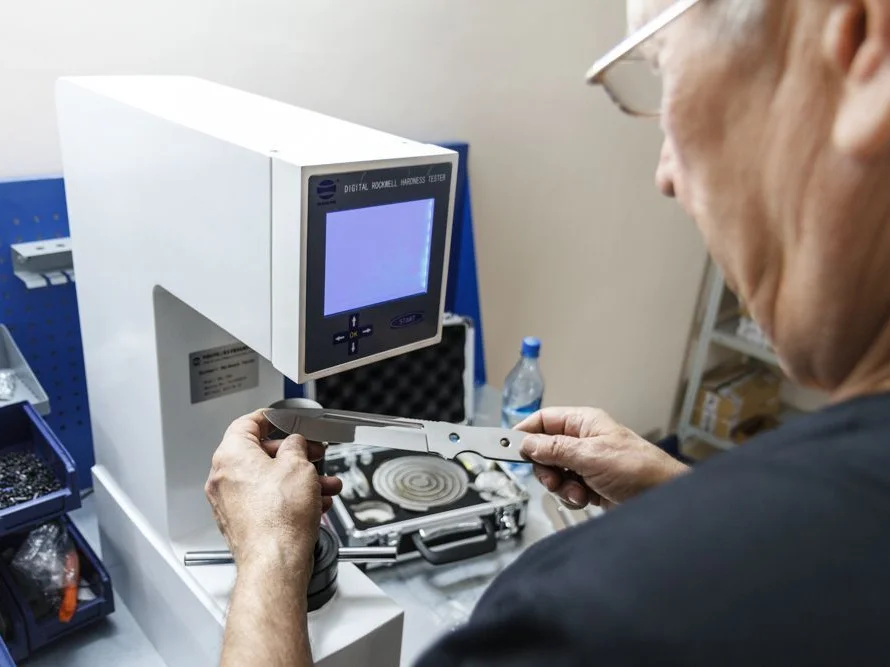
Rockwell hardness measurement on a Kizlyar Supreme blade
Hardness can show that a route changed something; metallography, phase analysis and mechanical tests are needed to show what changed and whether it is useful
What the evidence proves

Promising results, narrow boundaries

Each result below belongs to a named steel, specimen and test programme. The correct lesson is that thermocycling deserves controlled investigation—not that every blade will improve by the same amount.

Medium-carbon steel

The 1973 study supports grain refinement by cyclic rapid heating in its tested commercial steel. The authors measured both structural and mechanical changes; the result does not define a cycle for stainless or high-alloy knife steels.[2]

R18 high-speed steel

Shmatov and colleagues published an optimized five-cycle route and reported simultaneous gains in several measured properties and industrial tool performance. Those settings and gains remain specific to R18, their equipment and their test conditions.[4][5]

Х12МФ die steel

A 2016 study reported microstructural changes and approximately doubled component life in a 500 °C hot-deformation die application. This is valuable applied evidence, but a hot-working die is not a knife edge and its life ratio is not a cutting-life promise.[6]

Kizlyar Supreme production status

This is an educational research guide. Kizlyar Supreme is not presenting thermocycling here as a current standard production treatment. Any future production claim would require a documented, repeatable route for the exact steel and independent evidence that it improves the intended knife performance.

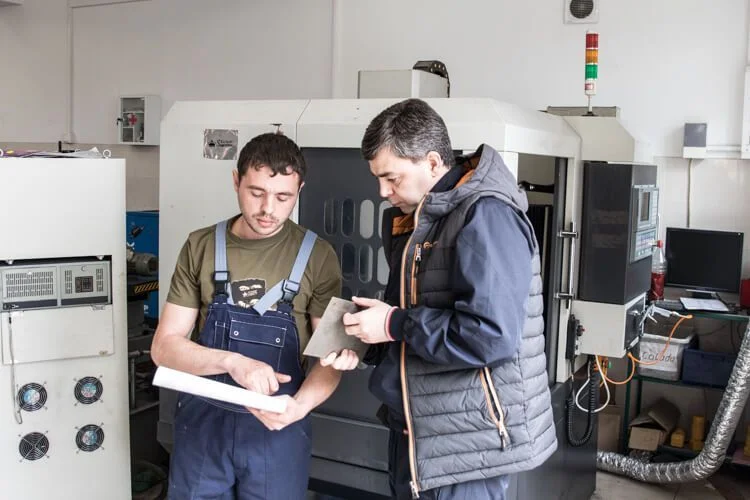
Kizlyar Supreme specialists checking a blade during manufacturing
A production treatment has to remain repeatable through real furnace loads, blade geometries, grinding and final inspection—not only on a laboratory coupon
Where knives fit

Microstructure supports the edge; it does not replace geometry

A refined and well-controlled microstructure can help a blade carry the intended hardness and resist fracture or deformation. But cutting performance is produced by the whole system: blade profile, thickness behind the edge, apex angle, edge radius and finish, steel, hardness, microstructure, task and user technique.

A 2023 experimental knife study found measurable effects from hardness, blade angle and edge micro-geometry.[9] This matters when interpreting thermocycling research: even a real metallurgical improvement cannot be converted into a universal percentage gain in cutting without controlling geometry and the test medium.

Powder-metallurgy steels also begin with a comparatively fine, homogeneous structure and evenly distributed carbides.[8] That may change their room for improvement, but it does not predict the answer. A powder steel still needs its own control group and its own evidence.

A credible development programme

How a treatment earns a production claim

A convincing programme starts with a question—such as improved edge stability at a fixed hardness—not with a preferred answer. The conventional, steelmaker-based route remains the control.

01

Define the material

Record steel grade, supplier, melt or batch, starting condition, blade geometry and the current reference route. Use the steelmaker’s data and transformation information as the safe starting framework.

02

Instrument the cycle

Measure the blade or representative load with thermocouples; record heating and cooling rates, peak temperatures, holds, atmosphere, quench delay and furnace loading—not only the controller setpoint.

03

Compare matched groups

Use samples from the same material batch and randomize conventional controls and candidate cycles. Repeat the work across more than one run so furnace position or one unusual coupon cannot decide the result.

04

Measure mechanisms

Combine hardness mapping with metallography, prior-austenite grain assessment, carbide examination and retained-austenite measurement where relevant. Check distortion, decarburization and cracking.

05

Test the property balance

Measure toughness or edge stability as well as hardness and wear. For stainless grades, include corrosion checks. A gain in one metric is not automatically a better knife.

06

Validate complete knives

Test matched geometry, sharpening and target media; document failures; then prove process capability in production loads before making a model-level claim.

Why no temperatures are published here

A cycle optimized for R18, Х12МФ or a medium-carbon research steel can cause grain growth, excess retained austenite, carbide-network changes, decarburization, distortion or cracking in another alloy or geometry. A scientific article should explain the logic without turning one experiment into an unsafe universal recipe.

Thermocycling FAQ

Clear answers about cyclic heat treatment

What is thermocycling of steel?

It is a family of treatments that repeatedly heat and cool steel through defined temperature ranges. Different routes target different transformations, so the complete time-temperature path must be stated.

Can thermocycling refine steel grain?

Yes, some rapid cyclic austenitization studies have demonstrated substantial grain refinement in specific steels. Whether it occurs in another alloy depends on nucleation, grain growth, carbide behaviour and the exact cycle.

How many thermocycles are best?

There is no universal number. One historical study reached its reported result after four cycles and an R18 programme used five, but those values belong to their materials and methods. Further cycles can stop helping or cause unwanted growth and cost.

Is thermocycling the same as cryogenic treatment?

No. Cryogenic treatment usually means a controlled sub-zero step after quenching. Thermocycling repeats heating and cooling and may cross one or more transformation ranges. A particular research route could include both, but the terms are not synonyms.

Does thermocycling guarantee longer knife edge life?

No. Published gains for high-speed tools or hot-working dies cannot be transferred directly to knives. Edge life also depends on geometry, sharpening, hardness, carbide structure, toughness, the material being cut and the test method.

Does Kizlyar Supreme currently thermocycle its knife blades?

Kizlyar Supreme is not presenting thermocycling in this guide as a current standard production treatment. A production claim would be made only for a documented steel- and model-specific route after validation.

Sources and further reading

Evidence behind this guide

  1. R. A. Grange, The Rapid Heat Treatment of Steel, Metallurgical Transactions 2 (1971), 65–78 — foundational rapid-heating and grain-refinement research
  2. S. Mahajan, C. S. Pande and M. A. Imam, Grain refinement of steel by cyclic rapid heating, Metallography 6(4) (1973), 337–345 — four-cycle grain-refinement and mechanical-property study
  3. US Reissue Patent 27,505, Method for producing ultrafine grained steel — Grange’s historical cyclic rapid-heating method and its stated limits
  4. Shmatov et al., Optimization and computer design of the high-speed steel R18 thermocyclic treatment process, Science & Technique 6 (2009), 20–25 — published R18 optimization study
  5. Shmatov, Methods of thermocyclic treatment for volumetric strengthening of steel tools, International Journal of Applied and Fundamental Research 11 (2021) — full journal issue containing the applied review of tool-steel routes and limitations
  6. Mordasov and Zotov, Thermocyclic treatment of Х12МФ dies for hot-deformation service, Transactions TSTU 22(3) (2016), 481–490 — microstructure and industrial die-service evidence
  7. V. K. Fedyukin, Thermocyclic Treatment of Steels and Cast Irons, Mashinostroenie (1977) — bibliographic record for the Soviet monograph
  8. Erasteel, Cutting Tools Application Guide — powder-metallurgy microstructure and carbide-distribution background
  9. Zhang et al., A Comprehensive Understanding of Knife Cutting, Materials 16(15) (2023), 5375 — measured effects of hardness, blade angle and edge micro-geometry
  10. Uddeholm, Heat Treatment of Tool Steel — grade-specific hardening, grain growth, carbide, distortion and verification context
Specialist contribution: We thank Dmitry Schneider, Technical Consultant at High Performance Metals Company Limited (ООО «ВЭМ»)—one of Kizlyar Supreme’s suppliers of high-performance steels—for his contribution and specialist expertise. This guide adapts a three-part ООО «ВЭМ» technical series with permission. Its historical leads, mechanisms and R18 example were checked against the public sources above; the supplier conversation is not presented as public proof, exact proprietary cycles are omitted, and industrial-tool results are not converted into knife-performance promises.

Demand a control, not a slogan

A meaningful heat-treatment claim identifies the steel, complete route, comparison method and property balance it actually demonstrated.

Explore materials & technologies