

Found an error? Please let us know.
We are always improving, and your feedback helps us make the website better.
MATERIALS • SHEATH ENGINEERING
Polypropylene for Precision-Fit Knife Sheaths
Secure retention, smooth extraction and dependable carry—engineered as part of the knife system.
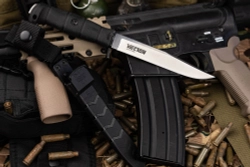

Designed as one system: sheath geometry, retention points and controlled flexibility are matched to the knife—not selected as an afterthought.

WHY THE SHEATH MATTERS
A knife sheath is not packaging added after the blade is finished. It is a working part of the knife system. Retention, extraction, edge protection, drainage, comfort and mounting options all affect how confidently the knife can be carried and used. Kizlyar Supreme treats sheath design as engineering: the knife and sheath are developed to work together.
WHAT IS POLYPROPYLENE?
Polypropylene (PP) is a lightweight thermoplastic valued for very low moisture absorption, chemical resistance, fatigue resistance and its ability to be moulded accurately. These characteristics make it especially useful for outdoor and tactical knife sheaths exposed to rain, mud, sweat, temperature changes and repeated drawing.
A SHORT HISTORY OF POLYPROPYLENE
Modern polypropylene emerged from the rapid development of polymer science after the Second World War. In 1951, J. Paul Hogan and Robert L. Banks produced crystalline polypropylene at Phillips Petroleum. In 1954, Giulio Natta polymerised crystalline polypropylene using advances in catalyst chemistry associated with Karl Ziegler. These discoveries helped make controlled industrial production practical, and commercial use expanded rapidly from the late 1950s.
Today, polypropylene is not a single universal recipe. Manufacturers can adjust molecular structure, copolymers, modifiers and processing conditions to create grades with different stiffness, impact behaviour, surface feel and forming characteristics. That ability to tune the material is central to its value in a precision sheath.
Read the American Chemical Society’s history of polypropylene.
CUSTOM PP BLENDS FOR KNIFE USE
Kizlyar Supreme does not treat polypropylene as a generic commodity plastic. We specify, test and refine custom PP blends for knife sheaths. The objective is not simply to make a hard shell. Material behaviour, wall thickness, moulded geometry and retention points are tuned together to create dependable hold and a deliberate, comfortable draw.
WHY POLYPROPYLENE WORKS
• Secure retention — moulded geometry engages the knife at carefully chosen contact points so it stays in place during movement and transport.
• Smooth extraction — controlled flexibility helps the sheath release predictably without an awkward struggle.
• Edge-conscious contact — PP is selected where contact behaviour matters. Its blend and geometry can reduce unnecessary abrasion during repeated drawing.
• Moisture resistance — the material does not swell or rot and is easy to rinse after wet or dirty use.
• Low weight — a strong moulded sheath adds little unnecessary mass to the carry system.
• Design freedom — attachment holes, drainage, clips and retention features can be engineered into a compact shape.
TWO CONSTRUCTIONS, ONE PURPOSE
Some Kizlyar Supreme sheaths are moulded wholly from polypropylene. Other designs use a precision polypropylene insert inside a ballistic-nylon outer carrier. The first approach creates a compact, weather-resistant shell; the second combines a controlled inner interface with flexible mounting and carry options. In both cases, the sheath is engineered around the knife rather than selected as an afterthought.
RETENTION IS ENGINEERED, NOT ACCIDENTAL
A well-designed sheath must hold the knife securely, release it predictably and remain comfortable in actual carry. Kizlyar Supreme evaluates contact surfaces, draw direction, mounting system and the behaviour of the sheath as a complete assembly. A material specification alone never tells the whole story.
CARE
Rinse away grit with clean water, allow the sheath to dry and check that debris has not collected around retention points. Avoid unnecessary high heat or storage directly against heating equipment. If the draw changes, inspect and clean both the knife and sheath before use.
HOW TO READJUST POLYPROPYLENE SHEATH RETENTION
This short procedure summarises Victor’s official Kizlyar Supreme demonstration for minor retention adjustment in moulded polypropylene and polyamide sheaths. It is not a repair method for a cracked, deeply deformed or unsafe sheath; contact Kizlyar Supreme service in those cases.
Before you start
Work in a well-ventilated area away from flammable materials. Wear heat-resistant gloves and eye protection. Use a heat gun, a padded vice or clamp, and paper, cloth, cardboard, felt or another soft pad to protect the sheath from the vice jaws. Keep the cutting edge controlled at all times and never use an open flame.
1. Confirm what needs changing. Decide whether the knife is too loose or too tight and identify the small retention area responsible. Do not heat the entire sheath when only one local point needs adjustment.
2. Heat gradually and evenly. Victor uses a heat gun set to 220°C for polypropylene and polyamide. This is the heat gun’s air setting—not the desired temperature of the plastic. Keep the nozzle approximately 3–4 cm from the surface, keep it moving and warm the intended area evenly. Stop if the surface begins to gloss, sag, smoke or melt. The video notes that boiling water may sometimes substitute for a heat gun, but different materials and constructions respond differently.
3. Check for controlled pliability. The target area should become noticeably softer and easier to form. Victor judges this by feel, but at home use heat-resistant gloves or a suitable non-contact temperature tool rather than bare fingers.
4. To tighten retention, apply modest local pressure. Place a soft pad between the sheath and the vice or clamp, then compress only the intended retention point. Excessive pressure can create gaps, excessive draw force or unnecessary wear on the handle.
5. Let the sheath cool completely while held in position. Leave the adjusted area clamped until it has returned to approximately room temperature—Victor allows about 10–15 minutes. Do not reinsert the knife while a tightened sheath is still hot, because the knife can push the softened material outward again.
6. To loosen retention, work in very small increments. Reheat only the tight retention area, then cautiously insert and remove the knife a few times while the material is pliable. Do not leave the knife inside a very hot sheath for an extended period; it can expand the sheath too far and create play.
7. Test conservatively. Once the sheath is cool, check the draw with the blade pointed in a safe direction. The aim is secure retention without rattle, but not so much clamping force that one-handed drawing becomes difficult or the handle is abraded. Repeat only in small increments.
Important: sheath geometry, wall thickness and plastic grade vary. If you cannot identify the correct retention point, the sheath is under warranty, or the result could affect safe carry, stop and contact Kizlyar Supreme.
Watch the full official demonstration below.
FREQUENTLY ASKED QUESTIONS
Does polypropylene absorb water?
PP has very low moisture absorption, helping it remain dimensionally stable in wet outdoor conditions. It will not swell or rot like an untreated natural material.
Why use a custom PP blend instead of generic plastic?
A useful knife sheath needs a specific balance of stiffness, resilience, surface behaviour and mouldability. Kizlyar Supreme combines a purpose-selected blend with controlled wall thickness, model-specific geometry and practical attachment features.
Can a polypropylene sheath dull a knife?
Any sheath can affect an edge if grit is trapped inside or if the edge repeatedly scrapes an unsuitable contact surface. Kizlyar Supreme uses PP where controlled contact behaviour matters and engineers retention away from unnecessary edge contact. Keeping the sheath clean remains important.
Is polypropylene the same as Kydex?
No. Both are thermoplastics used for sheaths, but their stiffness, forming methods, surface behaviour and construction options differ. The best material depends on the knife and intended carry system.
Why use a wholly moulded sheath in one design and a PP insert in another?
A wholly moulded sheath can be compact, lightweight and weather resistant. A PP insert inside ballistic nylon combines a precise inner interface with flexible mounting, quieter carry and additional exterior attachment options.
Can the sheath be washed?
Yes. Rinse it with clean water, remove trapped particles and let it dry completely before storage. Avoid aggressive solvents unless Kizlyar Supreme has confirmed compatibility with that exact sheath.
Can a polypropylene sheath be reshaped at home?
Minor retention adjustments may be possible because polypropylene is thermoplastic, but this is a workshop-style procedure rather than routine care. Kizlyar Supreme’s official demonstration covers polypropylene, polyamide, ABS and Kydex and explains that each construction behaves differently. If the sheath is under warranty or safe retention is in doubt, contact Kizlyar Supreme before applying heat.
At what temperature can polypropylene be adjusted?
In Kizlyar Supreme’s official demonstration, Victor sets the heat gun to 220°C when working with polypropylene and polyamide. This is the heat gun’s air setting—not a target temperature for the sheath itself. He recommends gradual heating rather than overheating, keeps the nozzle approximately 3–4 cm from the surface and warns that the plastic can melt. Different blends, thicknesses and tools respond differently, so there is no universal sheath-surface temperature.
Use a well-ventilated workspace, heat-resistant gloves and eye protection; keep the heat source moving, never use an open flame and keep hands clear of the cutting edge. Hold the adjusted area in position until it returns to approximately room temperature. If you are unsure, use Kizlyar Supreme service rather than risking unsafe retention or damage.
Watch Kizlyar Supreme’s official Plastic Sheaths: Customization Tips video (the relevant polypropylene and polyamide demonstration begins around 5:30).
Will ordinary cold or heat damage the sheath?
The selected blend is intended for real outdoor carry, but extreme or prolonged heat can deform any thermoplastic. Do not leave the sheath against a heater, hot machinery or another concentrated heat source. Inspect retention after any unusual temperature exposure.
When should the sheath be serviced or replaced?
Stop using it if the knife no longer retains securely, if the sheath is cracked or deeply deformed, or if the blade contacts the sheath abnormally. Clean it first; if the issue remains, contact Kizlyar Supreme for advice.
Return to the Materials section to compare polypropylene with Kydex, ballistic nylon, polyamide and other materials used by Kizlyar Supreme.
A knife sheath is not packaging added after the blade is finished. It is a working part of the knife system. Retention, extraction, edge protection, drainage, comfort and mounting options all affect how confidently the knife can be carried and used. Kizlyar Supreme treats sheath design as engineering: the knife and sheath are developed to work together.
WHAT IS POLYPROPYLENE?
Polypropylene (PP) is a lightweight thermoplastic valued for very low moisture absorption, chemical resistance, fatigue resistance and its ability to be moulded accurately. These characteristics make it especially useful for outdoor and tactical knife sheaths exposed to rain, mud, sweat, temperature changes and repeated drawing.
A SHORT HISTORY OF POLYPROPYLENE
Modern polypropylene emerged from the rapid development of polymer science after the Second World War. In 1951, J. Paul Hogan and Robert L. Banks produced crystalline polypropylene at Phillips Petroleum. In 1954, Giulio Natta polymerised crystalline polypropylene using advances in catalyst chemistry associated with Karl Ziegler. These discoveries helped make controlled industrial production practical, and commercial use expanded rapidly from the late 1950s.
Today, polypropylene is not a single universal recipe. Manufacturers can adjust molecular structure, copolymers, modifiers and processing conditions to create grades with different stiffness, impact behaviour, surface feel and forming characteristics. That ability to tune the material is central to its value in a precision sheath.
Read the American Chemical Society’s history of polypropylene.
CUSTOM PP BLENDS FOR KNIFE USE
Kizlyar Supreme does not treat polypropylene as a generic commodity plastic. We specify, test and refine custom PP blends for knife sheaths. The objective is not simply to make a hard shell. Material behaviour, wall thickness, moulded geometry and retention points are tuned together to create dependable hold and a deliberate, comfortable draw.
WHY POLYPROPYLENE WORKS
• Secure retention — moulded geometry engages the knife at carefully chosen contact points so it stays in place during movement and transport.
• Smooth extraction — controlled flexibility helps the sheath release predictably without an awkward struggle.
• Edge-conscious contact — PP is selected where contact behaviour matters. Its blend and geometry can reduce unnecessary abrasion during repeated drawing.
• Moisture resistance — the material does not swell or rot and is easy to rinse after wet or dirty use.
• Low weight — a strong moulded sheath adds little unnecessary mass to the carry system.
• Design freedom — attachment holes, drainage, clips and retention features can be engineered into a compact shape.
TWO CONSTRUCTIONS, ONE PURPOSE
Some Kizlyar Supreme sheaths are moulded wholly from polypropylene. Other designs use a precision polypropylene insert inside a ballistic-nylon outer carrier. The first approach creates a compact, weather-resistant shell; the second combines a controlled inner interface with flexible mounting and carry options. In both cases, the sheath is engineered around the knife rather than selected as an afterthought.
RETENTION IS ENGINEERED, NOT ACCIDENTAL
A well-designed sheath must hold the knife securely, release it predictably and remain comfortable in actual carry. Kizlyar Supreme evaluates contact surfaces, draw direction, mounting system and the behaviour of the sheath as a complete assembly. A material specification alone never tells the whole story.
CARE
Rinse away grit with clean water, allow the sheath to dry and check that debris has not collected around retention points. Avoid unnecessary high heat or storage directly against heating equipment. If the draw changes, inspect and clean both the knife and sheath before use.
HOW TO READJUST POLYPROPYLENE SHEATH RETENTION
This short procedure summarises Victor’s official Kizlyar Supreme demonstration for minor retention adjustment in moulded polypropylene and polyamide sheaths. It is not a repair method for a cracked, deeply deformed or unsafe sheath; contact Kizlyar Supreme service in those cases.
Before you start
Work in a well-ventilated area away from flammable materials. Wear heat-resistant gloves and eye protection. Use a heat gun, a padded vice or clamp, and paper, cloth, cardboard, felt or another soft pad to protect the sheath from the vice jaws. Keep the cutting edge controlled at all times and never use an open flame.
1. Confirm what needs changing. Decide whether the knife is too loose or too tight and identify the small retention area responsible. Do not heat the entire sheath when only one local point needs adjustment.
2. Heat gradually and evenly. Victor uses a heat gun set to 220°C for polypropylene and polyamide. This is the heat gun’s air setting—not the desired temperature of the plastic. Keep the nozzle approximately 3–4 cm from the surface, keep it moving and warm the intended area evenly. Stop if the surface begins to gloss, sag, smoke or melt. The video notes that boiling water may sometimes substitute for a heat gun, but different materials and constructions respond differently.
3. Check for controlled pliability. The target area should become noticeably softer and easier to form. Victor judges this by feel, but at home use heat-resistant gloves or a suitable non-contact temperature tool rather than bare fingers.
4. To tighten retention, apply modest local pressure. Place a soft pad between the sheath and the vice or clamp, then compress only the intended retention point. Excessive pressure can create gaps, excessive draw force or unnecessary wear on the handle.
5. Let the sheath cool completely while held in position. Leave the adjusted area clamped until it has returned to approximately room temperature—Victor allows about 10–15 minutes. Do not reinsert the knife while a tightened sheath is still hot, because the knife can push the softened material outward again.
6. To loosen retention, work in very small increments. Reheat only the tight retention area, then cautiously insert and remove the knife a few times while the material is pliable. Do not leave the knife inside a very hot sheath for an extended period; it can expand the sheath too far and create play.
7. Test conservatively. Once the sheath is cool, check the draw with the blade pointed in a safe direction. The aim is secure retention without rattle, but not so much clamping force that one-handed drawing becomes difficult or the handle is abraded. Repeat only in small increments.
Important: sheath geometry, wall thickness and plastic grade vary. If you cannot identify the correct retention point, the sheath is under warranty, or the result could affect safe carry, stop and contact Kizlyar Supreme.
Watch the full official demonstration below.
FREQUENTLY ASKED QUESTIONS
Does polypropylene absorb water?
PP has very low moisture absorption, helping it remain dimensionally stable in wet outdoor conditions. It will not swell or rot like an untreated natural material.
Why use a custom PP blend instead of generic plastic?
A useful knife sheath needs a specific balance of stiffness, resilience, surface behaviour and mouldability. Kizlyar Supreme combines a purpose-selected blend with controlled wall thickness, model-specific geometry and practical attachment features.
Can a polypropylene sheath dull a knife?
Any sheath can affect an edge if grit is trapped inside or if the edge repeatedly scrapes an unsuitable contact surface. Kizlyar Supreme uses PP where controlled contact behaviour matters and engineers retention away from unnecessary edge contact. Keeping the sheath clean remains important.
Is polypropylene the same as Kydex?
No. Both are thermoplastics used for sheaths, but their stiffness, forming methods, surface behaviour and construction options differ. The best material depends on the knife and intended carry system.
Why use a wholly moulded sheath in one design and a PP insert in another?
A wholly moulded sheath can be compact, lightweight and weather resistant. A PP insert inside ballistic nylon combines a precise inner interface with flexible mounting, quieter carry and additional exterior attachment options.
Can the sheath be washed?
Yes. Rinse it with clean water, remove trapped particles and let it dry completely before storage. Avoid aggressive solvents unless Kizlyar Supreme has confirmed compatibility with that exact sheath.
Can a polypropylene sheath be reshaped at home?
Minor retention adjustments may be possible because polypropylene is thermoplastic, but this is a workshop-style procedure rather than routine care. Kizlyar Supreme’s official demonstration covers polypropylene, polyamide, ABS and Kydex and explains that each construction behaves differently. If the sheath is under warranty or safe retention is in doubt, contact Kizlyar Supreme before applying heat.
At what temperature can polypropylene be adjusted?
In Kizlyar Supreme’s official demonstration, Victor sets the heat gun to 220°C when working with polypropylene and polyamide. This is the heat gun’s air setting—not a target temperature for the sheath itself. He recommends gradual heating rather than overheating, keeps the nozzle approximately 3–4 cm from the surface and warns that the plastic can melt. Different blends, thicknesses and tools respond differently, so there is no universal sheath-surface temperature.
Use a well-ventilated workspace, heat-resistant gloves and eye protection; keep the heat source moving, never use an open flame and keep hands clear of the cutting edge. Hold the adjusted area in position until it returns to approximately room temperature. If you are unsure, use Kizlyar Supreme service rather than risking unsafe retention or damage.
Watch Kizlyar Supreme’s official Plastic Sheaths: Customization Tips video (the relevant polypropylene and polyamide demonstration begins around 5:30).
Will ordinary cold or heat damage the sheath?
The selected blend is intended for real outdoor carry, but extreme or prolonged heat can deform any thermoplastic. Do not leave the sheath against a heater, hot machinery or another concentrated heat source. Inspect retention after any unusual temperature exposure.
When should the sheath be serviced or replaced?
Stop using it if the knife no longer retains securely, if the sheath is cracked or deeply deformed, or if the blade contacts the sheath abnormally. Clean it first; if the issue remains, contact Kizlyar Supreme for advice.
Return to the Materials section to compare polypropylene with Kydex, ballistic nylon, polyamide and other materials used by Kizlyar Supreme.