


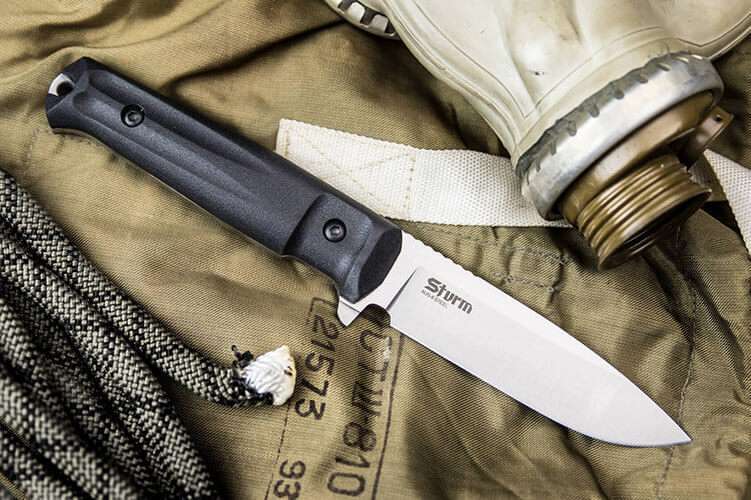

Wet–dry cycles accelerate trouble
Condensation, pocket sweat, repeated washing and a wet sheath keep renewing the conditions corrosion needs.


Find your knife
From compact everyday carry to full-size field tools, start with the way you plan to use your knife.
Start here
Built for the job
See how steels, handle materials, sheath systems and controlled processes become a complete Kizlyar Supreme knife.
Explore the essentials
 The complete guideOpen Materials & Technologies
  Explore the hub sectionBlade steels
  Explore the hub sectionTechnologies & finishes
 Evidence before adjectives
Explore how steel choice, heat treatment, geometry and finishing shape performance in the real world.
Featured expert guides
Made in Dagestan
Meet the people, production experience and ideas behind Kizlyar Supreme knives.
Company essentials
Here when you need us
Find warranty information, authorised dealers and direct help from Kizlyar Supreme.
Support essentials
Kizlyar Supreme knife care
A rusty mark does not mean the knife is finished. Act early, start with the gentlest method and protect the blade afterwards: most surface corrosion can be controlled without turning a working knife into a restoration project.

Real blades, visible corrosion and practical methods demonstrated by Kizlyar Supreme—not advice written at arm’s length.
Clean and dry the blade, soften the rust with a suitable protective oil, then wipe with a firm cloth. If a stain remains, move gradually to a clean pencil eraser, leather or an ultra-fine hand abrasive that follows the original finish. Stop before you damage a coating, marking, edge or collector-grade surface.
First, do not panic
“Stainless” knife steel is corrosion-resistant, not corrosion-proof. The same carbon that helps a blade harden and cut also changes the balance that its chromium must protect.
Condensation, pocket sweat, repeated washing and a wet sheath keep renewing the conditions corrosion needs.
Brine, acidic food residue and perspiration can remain as concentrated spots long after the knife was used.
Carbon and tool steels need more attention. Stainless grades make ownership easier, but finish, heat treatment and surface condition still matter.
Clean every active orange spot you can reach. Residual corrosion and rough pits hold moisture and make recurrence more likely.
Knowledge earned across many steels
Kizlyar Supreme offers the broadest steel selection in Russian serial knife manufacturing and one of the widest ranges among leading knife manufacturers worldwide. That breadth gives us direct production and ownership experience with easy-care stainless grades, semi-stainless tool steels and highly reactive carbon steels.
In our filmed comparison, blades were exposed to water and air, then kept for further observation before cleaning. The result is a useful lesson for owners: different steels rust at different speeds, but quick maintenance is far easier than correcting deep, neglected pitting.
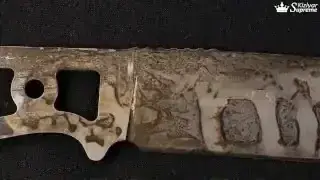
Gentlest method first
Secure the knife, keep fingers clear of the edge and test any product on a small, inconspicuous area. A valuable, coated or deeply pitted blade deserves advice before aggressive work.
Remove dirt and food residue with mild detergent where appropriate, rinse and dry completely. Good light will show which marks are loose surface bloom and which have become pits. Protect the cutting edge while you work, but do not leave adhesive against the blade longer than necessary.
Apply a small amount of a knife-appropriate corrosion inhibitor or cleaning oil to a firm, clean cloth and work the affected area patiently. For heavier flaking rust, allow the product the contact time stated by its manufacturer before wiping. This first pass often removes the orange film and reveals the few spots that need more work.
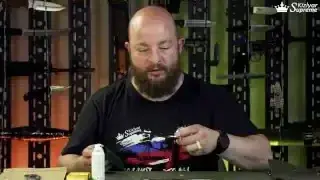
A firm white pencil eraser can provide controlled local friction without immediately reaching for metal abrasives. Work slowly, keep it away from the sharpened edge and check the finish often. A clean nylon pad intended for delicate surfaces can be an alternative; never use ordinary carbon-steel wool.
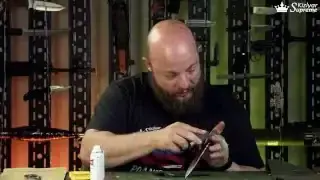
On a polished working blade, clean leather—with the finest suitable polishing compound only when needed—can remove marks more gently than coarse paper. It will still alter a satin, etched, coated or bead-textured surface, so match the method to the blade rather than treating every finish alike.

If active rust remains on a working blade, very fine wet-and-dry paper used by hand may be the practical last resort. Follow the existing satin direction, use light pressure and blend the whole affected plane rather than digging one bright hollow. This can fade laser markings and permanently change StoneWash, TacWash, coatings or collector finishes—contact us first if appearance matters.

Deep pitting at the edge, tip, lock, pivot or a load-bearing section; corrosion beneath a coating; an irreplaceable marking; or uncertainty about the blade finish are good reasons to send photographs to Kizlyar Supreme before proceeding.
Prevention takes seconds
The easiest rust removal is the one you never have to perform. A simple routine preserves the blade, its finish and the time you would rather spend using it.
Remove food, sap, salt and fingerprints; rinse only as the knife construction allows; then dry the blade, edge, pivot area and sheath contact points. Never put a knife in a dishwasher.
If the sheath becomes wet, remove the knife and dry both separately. A small cloth and suitable protective oil solve more problems than a heavy restoration kit.
Apply a thin, even protective film, avoid long-term storage in damp leather, and inspect carbon or tool-steel blades periodically—especially where temperature changes can create condensation.
Use only a product whose label specifically permits the intended food-contact use, such as an NSF H1-registered lubricant for incidental contact, and follow its directions. Otherwise remove all cleaner and oil before the blade touches food.
Protect the finish as well as the steel
Rust can be removed; an unnecessarily scarred blade, rounded grind or erased marking is much harder to put back.
Heat, detergent, salts, moving parts and prolonged warm condensation create exactly the environment a knife does not need.
It can scratch the finish and leave carbon-steel particles behind, creating new rust staining on stainless steel.
Bleach and chloride-rich products can stain or pit stainless steel. Use only a clearly suitable product and rinse as directed.
Acid-based converters can alter coatings, etching, laser marks and colour while still leaving mechanical clean-up to do. They are not our first-line knife-care method.
A wheel or grinder removes material quickly and unevenly, can round geometry and makes it harder to preserve a directional finish.
Moisture trapped in a folder or sheath keeps working out of sight. Dry the blade and its storage system separately.
Watch the complete demonstrations
The main film shows rust removal in real time. The supporting experiment explains why different knife steels and finishes demand different levels of care.
Oil and cloth, eraser, leather, fine abrasives and the limits of acid-based converters—demonstrated on visibly corroded blades.
A comparative exposure test with carbon, tool and stainless blade steels, plus practical advice for field use and long-term storage.
Quick owner answers
Not by itself. Corrosion depends on the steel, finish, heat treatment, moisture, salt, acids, fingerprints and storage. Carbon and many tool steels require routine protection; even stainless knife steels can stain in aggressive conditions. If a stainless blade corrodes unusually quickly or deeply despite appropriate use and care, send us photographs and the model details so we can help assess it.
Often, yes—especially when the corrosion is fresh and superficial. Begin with cleaning, drying, suitable oil and a firm cloth. A clean eraser is the next controlled step. Any abrasive or polish can alter a finish, so test carefully and stop early on coated, etched or collectible blades.
Use a product intended for metal corrosion protection and follow its label. If the blade may touch food, choose one specifically permitted for the intended food-contact use or remove it completely before food preparation. A very thin film is enough; more oil is not better.
Yes. Stainless means strongly corrosion-resistant rather than immune. Chromium supports a passive surface film, but salt, chlorides, acids, trapped moisture, contamination and neglected pits can overwhelm the protection locally.
For everyday carry, a dry sheath is normal. For long storage—especially with carbon or tool steel—keep the knife clean and lightly protected, avoid damp leather and inspect it periodically. If either knife or sheath gets wet, dry them separately.
Contact us before aggressive work if corrosion is deep, reaches the edge, tip, lock or pivot, spreads beneath a coating, threatens a marking, or appears unusually severe for the steel and conditions. A few clear photographs usually let us recommend the next sensible step quickly.
Evidence and practical sources
Kizlyar Supreme workshop demonstrations supply the knife-specific method. Independent metallurgy and cleaning guidance supports the cautions around passivation, contamination, abrasives, chlorides and food-contact lubricants.